

HORIZONTAL DIRECTIONAL DRILLING TOOLS: THE RIGHT TOOLING FOR GRUNDODRILL HDD RIGS

Horizontal Directional Drilling is becoming increasingly important wherever underground infrastructure has to be installed efficiently, precisely and with minimum impact on the surface.
Fibre-optic networks, electricity cables, water and gas pipelines, district heating systems, sewer lines and infrastructure for e-mobility all require reliable underground installation methods. At the same time, drilling projects are becoming more demanding. Longer drilling distances, larger pipe diameters, changing geological conditions and increasingly congested underground infrastructure place high demands on both the HDD drilling rig and the drilling tools.
The HDD market continues to grow strongly in 2026. Fibre and 5G projects remain one of the largest areas of application, while electricity infrastructure is gaining importance and water construction continues to generate substantial HDD activity. The rapid development of data centres is creating additional demand because these projects require extensive fibre, electricity, water and energy infrastructure.
For HDD contractors this means one thing above all: productivity is determined not only by the drilling rig.
The drilling rig, drill rods, pilot tools, drill heads, reamers, adapters, swivels and drilling fluid system have to work together as one complete drilling system.
This is particularly important when working with powerful HDD rigs such as the TRACTO GRUNDODRILL series.
GRUNDODRILL – HDD TECHNOLOGY FOR DIFFERENT APPLICATIONS
The GRUNDODRILL range covers a wide spectrum of steerable HDD applications.
TRACTO currently offers established GRUNDODRILL machines including the 5X, 15XP/T, 20N, 20ACS and 28Nplus, together with the new JCS/ACS generation consisting of the JCS130, JCS130E ELECTRIC, ACS130, JCS300 and ACS300. (Tracto)
The individual machines differ considerably in thrust and pull force, torque, drilling-fluid performance, rod system and intended application.
This also means that the drilling tools have to be selected accordingly.
A compact rig working on a short fibre installation in residential ground places completely different demands on the tooling than a 300 kN machine performing a long crossing or drilling through rock.
GRUNDODRILL 5X – COMPACT HDD FOR THE LAST MILE
Compact dimensions and high manoeuvrability are particularly important for utility installations in residential areas.
The GRUNDODRILL 5X is designed for exactly this type of application.
With 50 kN of thrust and pull force, 1,627 Nm of torque and a 38 l/min high-pressure bentonite pump, the compact drilling rig provides substantial performance despite its small dimensions. With a machine width of only 915 mm, it can operate in restricted working areas and narrow access routes. (Tracto)
This makes the 5X particularly suitable for last-mile applications, service connections and the installation of gas and water lines.
A removable rod magazine carries 61 m of drill rods as standard, while a larger 76 m magazine is available as an option. Different drilling functions from manual through automated operation simplify the drilling process. (Tracto)
For compact HDD applications, tool dimensions are particularly important.
The pilot tool and reamer must provide sufficient cutting and mixing performance without creating unnecessary resistance. At the same time, the bore geometry has to remain suitable for the relatively compact drill string and the available pullback capacity.
The objective is not simply to use the largest possible tool.
The objective is to achieve reliable drilling progress with the lowest reasonable load on the complete drilling system.
GRUNDODRILL 15XP/T – FLEXIBILITY FOR DISTRIBUTION NETWORK CONSTRUCTION
For larger installations, the GRUNDODRILL 15XP/T moves into a different performance class.
The two versions combine high operating comfort with intelligent drilling functions and automatic drilling processes.
The GRUNDODRILL 15XP provides approximately 147 kN of thrust and pull force, while the 15XPT reaches 160 kN. Depending on the version, torque reaches up to 6,500 Nm. TRACTO specifies pipe installations up to OD 400, with bore lengths of up to approximately 350 m for the 15XP and 400 m for the 15XPT. (Tracto)
Large onboard rod capacity allows long drilling distances to be completed with limited interruption.
The drilling-fluid system is equally important. Depending on the configuration, drilling-fluid capacity reaches up to 320 l/min, providing the flow required for larger backreaming operations. (Tracto)
This is where the relationship between the drilling rig and the reamer becomes especially important.
Increasing the diameter of the bore requires considerably more than pulling a larger cutting tool through the pilot bore.
Cutting geometry, soil displacement, drilling-fluid flow, removal of cuttings and the resulting pull force all have to be considered.
A correctly designed reamer assists the drilling rig.
An incorrectly matched reamer consumes its performance.
GRUNDODRILL 20N – PERFORMANCE FOR COMPLEX NETWORK CONSTRUCTION
The GRUNDODRILL 20N moves further into demanding distribution-network construction.
With 200 kN of thrust and pull force and continuously adjustable torque of up to 10,000 Nm, the machine is designed to adapt its drilling performance to changing jobsite requirements. (Tracto)
The 20N 4.5 uses 4.5 m drill rods and carries 60 rods on the machine. Its automatic rod handling system reduces idle time, while the onboard crane simplifies handling of rods and drilling accessories. Digital drilling-data functions form another part of the overall system. (Tracto)
Machines in this performance category create considerably higher loads on drilling tools.
The connection between drill rod and tool, the body of the reamer, cutters, nozzles and all highly loaded components must therefore be designed for the forces generated by the machine.
Torque capacity alone is not sufficient.
The geometry of the drilling tool determines how effectively the available torque is transferred into cutting and mixing the surrounding formation.
GRUNDODRILL 20ACS – WHEN GEOLOGY CHANGES
Ground conditions are rarely completely homogeneous.
A bore may begin in clay, continue through mixed soils and eventually encounter rock.
This is where an All Condition System becomes particularly valuable.
The GRUNDODRILL 20ACS can operate as both a jet drilling and rock drilling rig. It provides 200 kN of thrust and pull force and torque of up to 9,000 Nm. The machine uses different rod systems according to the drilling method and is designed for operation across different soils, including rock. (Tracto)
For hard-rock drilling, TRACTO uses ELICON twin-tube rods. High drilling-fluid capacity is maintained even on longer drilling sections, while automatic drilling, rod changing and rod lubrication support the drilling process. (Tracto)
For tooling manufacturers and HDD contractors, this illustrates an important principle.
There is no universal HDD tool for every geology.
Soft cohesive soils, sand, gravel, mixed formations and rock behave differently during pilot drilling and reaming.
The tool must therefore be selected according to the formation.
A reamer designed primarily for soil mixing has a different task from a tool required to cut competent rock.
GRUNDODRILL 28Nplus – HIGH PERFORMANCE FOR LARGE HDD PROJECTS
When drilling dimensions and distances increase, drilling-fluid capacity, torque and rod capacity become increasingly important.
The GRUNDODRILL 28Nplus provides 280 kN of thrust and pull force and maximum torque of 11,000 Nm. Its onboard drilling-fluid pump delivers up to 650 l/min, while the rod magazine carries 288 m of drill rods. TRACTO specifies installations up to OD 710 and backreaming diameters up to approximately 900 mm, depending on project conditions. (Tracto)
The combination of high torque and high drilling-fluid capacity is especially relevant during reaming.
As bore diameter increases, more material has to be cut, loosened, mixed and transported from the bore.
For this reason, drilling-fluid passages and nozzle positioning inside a reamer are not secondary details.
They are part of the cutting process.
The drilling fluid must reach the working area of the tool effectively. Cuttings must remain transportable. The bore must remain stable, and unnecessary accumulation of material around the reamer should be avoided.
For long and large-diameter HDD projects, these factors can have a direct influence on drilling speed and tool wear.
THE NEW GENERATION GRUNDODRILL
Automation, digitalisation and flexibility are becoming increasingly important throughout the HDD industry.
TRACTO’s new GRUNDODRILL generation reflects this development.
The machines are divided principally into two systems.
The Jet Condition System – JCS – uses single drill rods and is intended primarily for conventional soils and loose rock.
The All Condition System – ACS – uses different rod configurations, including twin-tube systems, to extend drilling capability into complex geology and rock. (Tracto)
The new generation combines automated drilling processes, modular machine configuration, digital applications, integrated locating information and remote operation.
The current range consists of the GRUNDODRILL JCS130, JCS130E ELECTRIC, ACS130, JCS300 and ACS300. (Tracto)
GRUNDODRILL JCS130 – AUTOMATED JET DRILLING
The GRUNDODRILL JCS130 is designed for productive steerable pipe installation in conventional soils and loose rock.
With 130 kN of thrust and pull force and 4,500 Nm of torque, the JCS130 is positioned for undercrossings and longitudinal installations up to OD 400. (Tracto)
One of the key developments is automation.
Drilling operations and rod handling can be automated, while remote operation gives the operator another way to control the machine according to jobsite requirements.
The machine uses ELICON EL-D67 drill rods. The rod system is designed for high drilling-fluid capacity and performance over longer distances. (Tracto)
For the drilling-tool system, high fluid capacity provides additional possibilities.
However, the tool itself must allow that capacity to be used effectively.
A restriction inside the reamer or incorrectly selected nozzle configuration can prevent the complete system from operating at its potential.
GRUNDODRILL JCS130E ELECTRIC – ELECTRIFICATION ENTERS HDD
One of the clearest equipment trends is electrification.
The GRUNDODRILL JCS130E ELECTRIC combines 130 kN of thrust and pull force with an electric drive system and is designed for jet drilling applications up to OD 400. (Tracto)
The drive concept combines an external electrical supply with an onboard buffer battery.
The battery provides additional power during peak loads and allows the machine to move and position itself on the jobsite without remaining permanently connected to the external power supply. (Tracto)
The machine retains the performance characteristics expected from the JCS platform, including 4,500 Nm maximum torque, a 168 m rod magazine and drilling-fluid pump options reaching 320 l/min. (Tracto)
Electric HDD technology changes the power source.
It does not change the basic requirements placed on the drilling tool.
Cutting efficiency remains important because every unnecessary load still requires energy.
Efficient tooling therefore becomes just as relevant – and potentially even more relevant – as HDD equipment becomes more sophisticated.
GRUNDODRILL ACS130 – ONE MACHINE FOR CHANGING GEOLOGY
The GRUNDODRILL ACS130 extends the new-generation concept into complex ground conditions and rock.
The machine provides 130 kN of thrust and pull force and 4,500 Nm of torque. Depending on the rod configuration and drilling method, it can operate with jet rods or twin-tube rods. TRACTO specifies jet drilling lengths up to approximately 300 m and rock drilling lengths up to approximately 200 m, subject to application and configuration. (Tracto)
This flexibility is particularly important where geology cannot be treated as one uniform formation.
Tool selection should follow the same principle.
Pilot tools, cutting structures and reamers should be adapted to the geology rather than selected only according to the nominal diameter of the bore.
In mixed ground, a tool must remain controllable and stable when drilling conditions change.
For rock applications, cutting efficiency and wear resistance become critical.
For loose formations, bore stability, fluid distribution and material transport may become the dominant factors.
GRUNDODRILL JCS300 – BUILT FOR DISTANCE
Long bores place different demands on an HDD system.
Rod capacity, drilling-fluid delivery, automation and repeatability become decisive.
The GRUNDODRILL JCS300 is a 300 kN jet drilling rig designed specifically for long, reproducible bores. It carries 70 rods, each 4.5 m long, providing approximately 315 m of drill rods onboard. TRACTO’s current technical information lists maximum torque of 13,000 Nm and drilling-fluid capacity of up to 750 l/min. (en.tracto.com)
Automatic drilling, rod handling and rod lubrication reduce secondary operations, while the mobile operating interface allows the rig to be controlled either from the cabin or remotely. (en.tracto.com)
For long bores, tooling performance has to remain consistent throughout the complete drilling distance.
A tool that performs efficiently during the first section but wears rapidly cannot provide an economical result.
Service life, wear distribution and cutting geometry therefore become important components of total drilling productivity.
GRUNDODRILL ACS300 – HDD PERFORMANCE IN ROCK
The GRUNDODRILL ACS300 brings the new-generation concept into the 300 kN rock-drilling category.
The machine provides 300 kN of thrust and pull force, maximum torque of 13,000 Nm and drilling-fluid capacity of up to 650 l/min. It is designed for installations through different geologies including solid rock. (Tracto)
A 231 kW Stage V Cummins engine supplies the required drive power, while automated drilling functions and a modular equipment concept support demanding drilling projects. (Tracto)
At this level of performance, the drilling tools become heavily loaded machine components.
Reamer body strength, connections, cutter attachment, wear protection and fluid passages must all be considered together.
A high-performance HDD rig cannot compensate indefinitely for an inefficient drilling tool.
The complete system is only as efficient as the interaction between the machine and everything connected to its drill string.
REAMERS – A CRITICAL PART OF HDD PRODUCTIVITY
Pilot drilling receives considerable attention because it defines the bore path.
But once the pilot bore reaches the exit point, another critical stage begins.
The pilot hole has to be enlarged to a diameter suitable for installation of the product pipe.
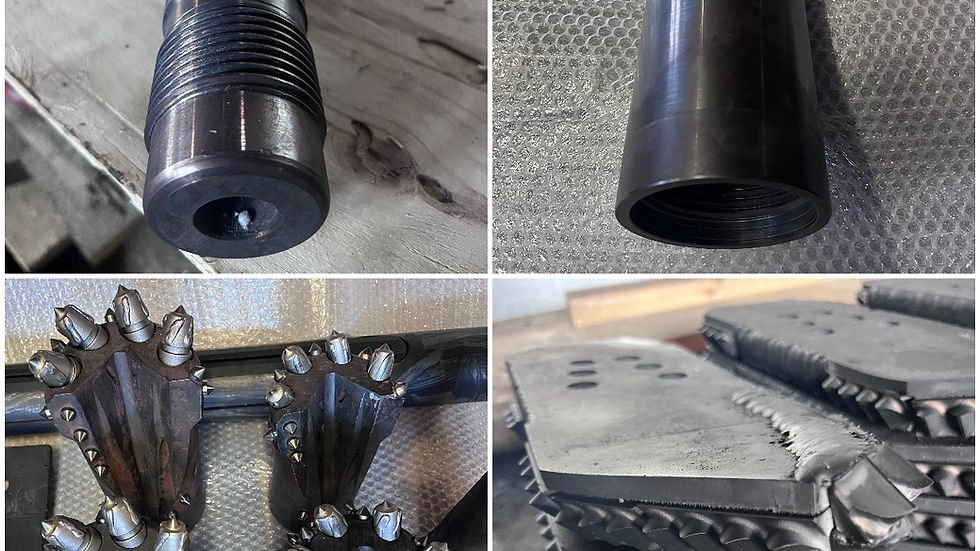
The reamer performs this work.
Its task is more complex than simply increasing the diameter.
The reamer has to cut or loosen the surrounding material, mix it with drilling fluid, allow the material to move through the annular space and produce a bore suitable for subsequent enlargement or final pipe installation.
Different ground conditions require different approaches.
In cohesive soil, the priority may be efficient cutting and mixing.
In sand and gravel, maintaining bore stability and controlling material movement becomes particularly important.
In mixed geology, the reamer has to remain stable when the formation changes.
In rock, the cutting system has to withstand high mechanical loads and abrasive wear.
For this reason, reamer selection should always consider geology, machine performance, pilot-hole diameter, required final diameter, drilling-fluid capacity, bore length and product-pipe dimensions.
DRILLING FLUID IS PART OF THE TOOLING SYSTEM
Modern GRUNDODRILL machines demonstrate how important drilling-fluid performance has become.
Depending on the model, drilling-fluid delivery ranges from compact systems such as the 38 l/min pump of the 5X to several hundred litres per minute on the largest GRUNDODRILL machines. (Tracto)
That capacity has to reach the right location.
Nozzle position, nozzle direction, internal fluid passages and the geometry around the cutting elements influence the way fluid interacts with the formation.
Effective fluid distribution can assist cutting, cooling, lubrication and material transport.
Poor fluid distribution can result in the opposite.
More pump capacity alone does not automatically create more productive drilling.
The complete hydraulic path from the drilling rig through the rod string and finally through the drilling tool has to work as one system.
DRILL RODS, CONNECTIONS AND ADAPTERS
Every metre of an HDD bore transfers forces through the drill string.
Push force, pullback force and torque are transferred from the drilling rig through the rods and connections to the working tool.
Longer drilling distances increase the importance of the rod system.
The new GRUNDODRILL generation therefore combines the drilling rigs with specifically matched ELICON jet and twin-tube rod systems. TRACTO also emphasizes drilling-fluid capacity and reduced bending radii as important characteristics of its new-generation rod concept. (Tracto)
Adapters and tool connections have to respect the same principle.
The connection should transfer the available machine torque and pull force without creating an unnecessary weak point between the drill string and the working tool.
Correct dimensions, material properties, machining quality and connection geometry are therefore fundamental requirements for reliable HDD tooling.
SWIVELS – PROTECTING THE PRODUCT PIPE DURING PULLBACK
Once the bore has been prepared, the product pipe has to be installed.
During pullback, the reamer may rotate while the product pipe should remain isolated from this rotation.
This is the role of the swivel.
Although comparatively small in relation to the drilling rig, the swivel performs a critical mechanical function.
Its load capacity should therefore correspond to the forces expected during pullback.
The same principle applies throughout HDD tooling.
A component should not be selected simply because its nominal dimensions appear suitable.
Its mechanical capacity must be compatible with the drilling system and the actual project.
DIGITALISATION AND AUTOMATION ARE CHANGING HDD
The HDD machine is becoming increasingly digital.
TRACTO integrates applications including BORE DATA for drilling documentation, QUICKPLANNER for bore planning and COMMANDER for fleet management into its digital ecosystem. The new GRUNDODRILL generation also combines machine information with locating data and supports remote-controlled drilling. (Tracto)
Locating technology is developing in parallel.
TRACTO currently highlights systems including DigiTrak ARES, which uses automatic frequency selection and intelligent signal processing for demanding HDD locating applications. (Tracto)
These developments improve the information available to the operator.
But they also make mechanical consistency more important.
When drilling parameters are accurately measured, logged and repeated, differences in tool performance become easier to identify.
Tool wear, drilling speed, torque requirements and pull forces increasingly form part of a measurable drilling process rather than relying solely on operator perception.
THE MACHINE AND THE TOOL MUST WORK AS ONE SYSTEM
The development of the GRUNDODRILL range demonstrates the direction in which HDD technology is moving.
Compact machines are becoming more capable.
Large machines are becoming more automated.
Rock drilling is becoming more flexible.
Digital documentation is becoming standard.
Remote operation is increasing.
Electric drive technology is entering the HDD market.
And drilling systems are becoming increasingly integrated.
But the basic principle remains unchanged.
The drilling rig supplies the performance.
The drilling tool transfers that performance into the ground.
The best results are achieved when both are correctly matched.
A powerful machine requires a tool capable of handling its torque and pull force.
A high-capacity drilling-fluid pump requires a tool capable of distributing that fluid effectively.
A long bore requires tooling with sufficient wear resistance and reliable connections.
Changing geology requires a drilling tool designed for the actual ground conditions.
And a productive HDD project requires every component – from the drilling rig and rods to the pilot head, reamer, adapter and swivel – to function as part of one complete system.
THE FUTURE OF HDD IS ALREADY UNDERGROUND
The continued expansion of fibre networks, electricity infrastructure, water systems, energy networks, e-mobility and data-centre infrastructure is creating substantial demand for trenchless installation technology. Current 2026 industry research continues to show strong HDD activity, with fibre/5G, water and electric installations among the largest areas of work. (Underground Infrastructure)
At the same time, HDD equipment is developing quickly.
Machines such as the GRUNDODRILL 5X demonstrate how much performance can now be packaged into a compact drilling rig.
The GRUNDODRILL 15XP/T, 20N, 20ACS and 28Nplus cover increasingly demanding utility and infrastructure projects.
The new JCS130, JCS130E ELECTRIC and ACS130 combine automation and digital technology with flexible drilling capabilities.
And at the top of the range, the JCS300 and ACS300 bring the same principles to long-distance and high-performance HDD projects. (Tracto)
The technology surrounding the rig must develop at the same pace.
More powerful, more automated and more efficient HDD machines require drilling tools capable of using that performance effectively.
Because successful Horizontal Directional Drilling is never only about the drilling rig.
It is about the complete drilling system.



Comments